
Ancestors on the Isle of Jersey
Captain Frederick La Cloche Nicolle (1826-1857) & Margaret Elizabeth Strudwicke (c. 1825-1856)
A Descendant’s Story
Each of us has sixteen pairs of great-great-great grandparents (3rd great grandparents for short) and each of these pairs has a unique and interesting story to be discovered. This story is about my 3rd great grandparents, Frederick La Cloche Nicolle (1826-1857) and Margaret Elizabeth Strudwicke (c. 1825-1856), who lived on the Isle of Jersey off the coast of France at the beginning of the Victorian Era. At first glance, it is clear they come from two very different worlds. Frederick was born on Jersey to aristocratic parents, Jean Nicolle and Esther Landhatherland, and was commissioned a Captain in the Royal Militia of the Island of Jersey. Margaret was born in England to a father, Jeffrey Lambert Strudwicke, who was a successful coal merchant and a member of England’s landed gentry. Margaret’s mother, Elizabeth Anne Hayes was born in Jamaica of English descent. It’s quite possible that Frederick spoke Norman French and Margaret spoke English as their first languages.
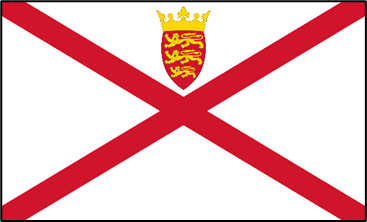

It was on the Isle of Jersey in the 1840’s that Frederick and Margaret’s paths crossed when Margaret’s father, Jeffrey Lambert Strudwicke, decided to take his family to the island to live during his retirement years. Over the course of ten years, Frederick and Margaret had four sons, Frederick, Percy Alfred, Francis, and Arthur Ernest, the youngest, who died in infancy. The three older brothers grew to adulthood and left Jersey, venturing off in different directions. Our family is descended from the eldest brother, Frederick, who is my 2nd great grandfather. This storytelling continues through six generations to arrive at our family in the present day.
As with previous ancestor stories on our family website, our research combines primary and secondary source documents with observations and speculations of our own in an attempt to make our ancestors’ journey more understandable. Our main goal is to share our discoveries with relatives and others who may be interested. Additionally, we include some historical context to further illuminate our ancestors’ daily lives. Much of the source material that was studied for writing this story can be found on our family tree on the Ancestry website. We have tried our best to be accurate but we also would like to hear about any mistakes that are found. As genealogy research is an ongoing endeavor, we welcome any new documents or stories from our readers that might add details to our storytelling.
As we researched and learned about our ancestors on the Island of Jersey, we quickly found that their birth, baptism, marriage, death, census, and other vital records have been well-preserved and are easy to access by family genealogists. For those who may be tracing their family trees back to Jersey, there are three archives on the island that we found particularly helpful. These sites allowed us to make many discoveries and their links are listed below.
Genealogy Archives – Island of Jersey
Office of the Superintendent Registrar – Government of Jersey. At present, the Office of the Superintendent Registrar is closed to the public but they can carry out limited family history research. For more information email researchsir@gov.je.
Jersey Heritage. This archive includes Church Records, Civil BMD Registers, Court Records, Civil Parishes, Maps, Aerial Photos, Museum Collections, and Archaeology Collections.
Jerripedia. This site enables those with connections to the island to trace their family histories and discover what the island was like in days gone by.
Middle Names
Our story begins in the 1820’s when Frederick La Cloche Nicolle and Margaret Elizabeth Strudwicke were born. They were both baptized in the Church of England; Frederick in St. Brelade, Jersey and Margaret in Croydon, England. Frederick’s baptism record shown below, provides a possible clue regarding the origin of his middle name, La Cloche. Translated from French, his godfather and godmother are noted as Reverend Philip La Cloche and his sister, Miss Jane La Cloche. Reverend La Cloche served as a curate for the parishes of St Ouen and St Lawrence and also as a clerk in the parish of St Helier. Throughout history in many cultures, children occasionally have been named after a member of the clergy who was close to the family. Margaret’s baptism record lists her father as Jeffrey Lambert Strudwicke who shares this name with his father. Going back one more generation, Jeffrey’s paternal grandmother had the maiden name Lambert. On occasion, Margaret used Lambert as her surname.

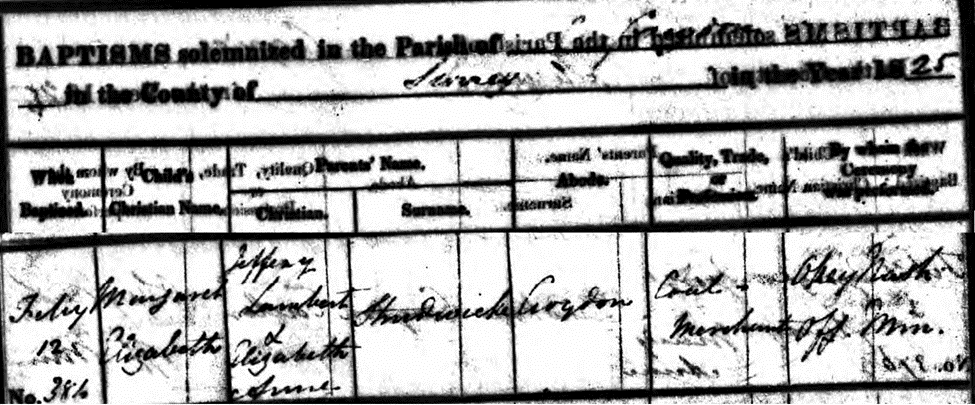
Before moving forward, we first set the stage by briefly discuss the Nicolle and Strudwicke families and in particular, identify the parents and siblings of Frederick and Margaret.
Frederic La Cloche Nicolle was born on November 1, 1826 in the Parish of St. Brelade on the Isle of Jersey. Frederick’s father was Jean Nicolle, a member of the longstanding Nicolle family in Jersey with roots in France going back to the 14th Century. Frederick’s mother was Esther Landhatherland who also descended from an upper-class Jersey family. Esther’s first marriage to Joshua Le Touzel (1750-1820) produced two sons, Joshua John and Francis Thomas, and a daughter, Esther Rachel. Esther’s second marriage to Jean Nicolle (1780-1829) produced the one son, Frederick La Cloche Nicolle, who then would have been a half-brother to Joshua, Francis, and Esther.
When Esther’s second husband, Jean Nicolle, died in 1829, their son Frederick La Cloche was just three years old. Since the name Jean Nicolle is extremely common during this period in Jersey, it proved challenging to determine his actual identity. Historically, the Nicolle and the Landhatherland families can be traced back through several generations in Jersey to the time of William the Conqueror, and the Battle of Hastings in 1066 when the Isle of Jersey was part of the Duchy of Normandy on the French mainland. In the 19th Century these families, who were mostly of Norman descent, were often bilingual with Norman-French as their first language and English being increasingly spoken in Jersey as immigration and trade from England increased and political and economic ties to France decreased. You could even say that most were trilingual speaking French as well which is quite a different language from Norman-French.

Many Men Named Jean Nicolle
As mentioned above, determining the true identity of the Jean Nicolle who was Frederick’s father required some research. In Jean’s Last Will and Testament, written in French in 1829, his wife Esther Landhatherland is designated as the executor of his estate and describes him as the son of Jean and a native of the Parish of Trinity who presently resides in the Parish of St Brelade. Besides leaving a large share of his estate to his wife Esther, he also bequeathed to the poor of Grouville and St Brelade, £8 of the order of the King each. He further expressed a desire to be buried in the Grouville cemetery. For context, Jersey is a small island, 46 square miles in area, and situated 14 miles off the French coast and 85 miles across the English Channel from the coast of England. Jersey is divided into twelve parishes shown in the map below with most parishes divided further into four or five vingtaines. Vingtaine in French translates to “about twenty” so about twenty households would comprise a vingtaine so they are equivalent to small towns.
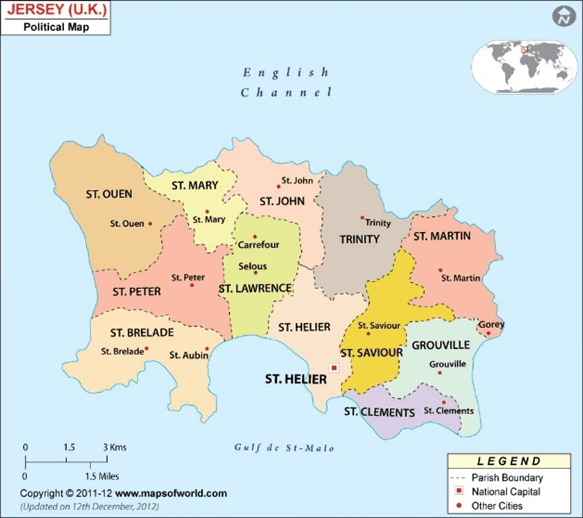
The first step was to input the name, Jean Nicolle, along with the range of years he might have been born, into the Jerripedia electronic database for Jersey birth, marriage, and death statistics. This search produced a long list of men named Jean Nicolle. Using clues from Jean’s will to focus on candidates who were born in the Parish of Trinity with a father also named Jean, it was possible to narrow this long list down to just a handful.
The next question was, “Why did Esther’s second husband, Jean Nicolle, request to be buried in Grouville?” Since Jean Nicolle was Esther’s second marriage might he have had an earlier marriage as well and could this somehow explain his desire to be buried in Grouville? Looking again at Jerripedia for marriages involving grooms named Jean Nicolle from our short list during this time period, one possibility of particular interest emerged. The bride was named Elizabeth Touzel (no relation to the Le Touzel family of Esther’s first husband). Elizabeth was born in 1778 in Grouville, the daughter of Francois Touzel and Anne du Parcq. Her being born in Grouville would support the notion that Jean Nicolle, Esther’s husband, may have wished to be buried near his first wife. This particular Jean Nicolle married Elizabeth Touzel (1778-1825) in 1801. At the time, he was living in St. Clement and she in Grouville. The couple had six children, Jean, Philippe, Betsey, Francois, Nancy, and Francois with the first Francois dying in infancy. If proven correct, these children would be older half-siblings of Frederick La Cloche Nicolle. On the 1815 Muster for all members of the Royal Militia of the Island of Jersey, Jean Nicolle, then age 35, from Grouville is listed as a Sergeant. This Muster was essentially a census of all adult males in Jersey.
Comparing Signatures
Proof was needed to verify that Elizabeth Touzel was indeed the first wife of the Jean Nicolle whose second wife was Esther Landhatherland. This in turn would show that this Jean Nicolle was the father of Frederick La Cloche Nicolle. A breakthrough discovery came involving the signature of Frederick La Cloche Nicolle who served as a witness at two separate weddings.
On May 1, 1849, Margaret Elizabeth Strudwicke’s brother, John Hayes Strudwicke was married to Elizabeth Anne Pike in the Parish of St. Ouen in Jersey. On the record showing the marriage was solemnized in the Parish of St. Ouen on Jersey, Frederick La Cloche Nicolle signed his name as a witness. The second witness was the sister of the groom, Margaret Elizabeth Strudwicke, who signed her name as Margaret Nicolle.
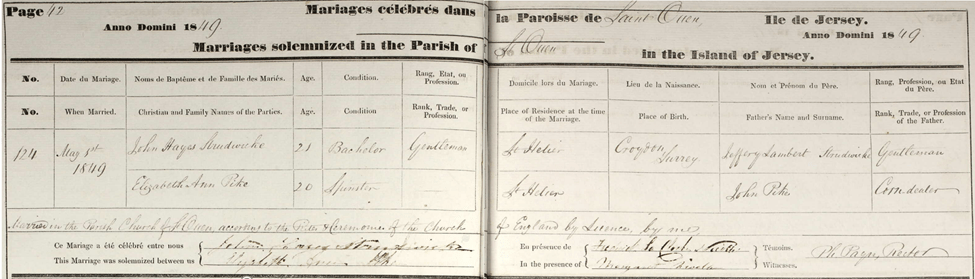
Two years later, there was another wedding which Frederick La Cloche Nicolle attended and served as a witness. The eldest son of Jean Nicolle and Elizabeth Touzel was also named Jean Nicolle. His eldest son was John Frederic Nicolle born in 1821 making him a grandson of Jean Nicolle and Elizabeth Touzel. On September 14, 1851, John Frederic Nicolle married Francoise (Fanny) Messervy in St. Saviour in Jersey. The witnesses to this marriage signed their names as F. L. C. Nicolle and E. F. Journeaux. The obvious conclusion is that this is the signature of Frederick La Cloche Nicolle.
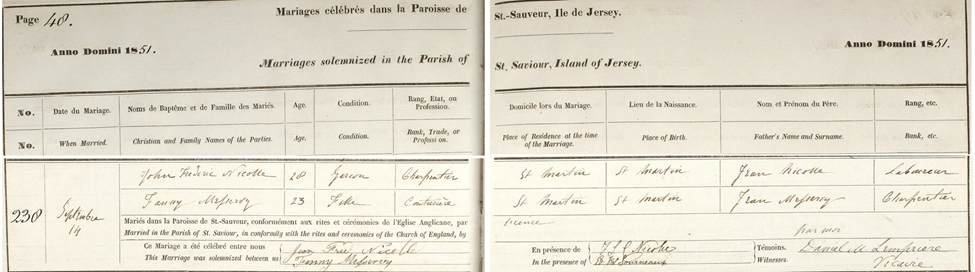
A visual comparison of the two signatures of Frederick La Cloche Nicolle, one with his full signature and the other with his initials and surname, makes a convincing argument that these signatures are written by the same person. In particular, the upper-case letters N and C are identifying components.

These two marriage records with the signatures can be found at the Jersey Heritage archive. So, the conclusion is that John Frederic invited his half-uncle, Frederick, who at this time was a Captain in the Royal Militia of the Island of Jersey living in St. Brelade to witness his wedding. This establishes a strong connection between the families of the two marriages of Jean Nicolle. Thus, the Jean Nicolle who married Elizabeth Touzel and the Jean Nicolle who married Esther Landhatherland are the same person.
To put it briefly, the father of Frederick La Cloche Nicolle was Jean Nicolle (1780-1829), a native of Trinity who was married twice. He married his first wife Elizabeth Touzel (1778-1825) in 1801 in Grouville where she was born. He married his second wife Esther Landhatherland (c.1785-1858) in 1825 in St. Helier. She was born in St. Brelade. Jean Nicolle died in 1829 and was buried in Grouville according to his wishes.
Frederick’s Half-Siblings
This identification of Frederick’s father, Jean Nicolle, combined with what is known of Frederick’s mother, Esther (Landhatherland) Le Touzel, completes the details of Frederick La Cloche Nicolle’s immediate family. Frederick was born on November 1, 1826 in St. Brelade, the only child of Jean Nicolle and Esther Landhatherland. Since Jean and Esther each had previous marriages, Frederick had a total of nine half-siblings; three on his mother’s side, Joshua John, Francis Thomas, and Esther Rachel Le Touzel and six on his father’s side, Jean, Philippe, Betsey, Francois (died in infancy), Nancy, and Francois Nicolle.
Margaret’s Siblings
By contrast to Frederick La Cloche Nicolle’s ancestry on the Isle of Jersey, Margaret Elizabeth Strudwicke’s roots were in England in the County of Surrey in South London. Margaret was baptized on February 12, 1825 at Saint John the Baptist Church in the town of Croydon. No birth record has been found so we only know she was born some weeks or months before February 12 in 1824 or 1825. As mentioned above, her father was Jeffrey Lambert Strudwicke and her mother was Elizabeth Anne (Hayes) Strudwicke. On Margaret’s baptism record, her father Jeffrey is described as a coal merchant. On several other family records including the marriage certificate of his son John Hayes Strudwicke, shown above, he is designated with the rank of Gentleman. This was the lowest rank of the landed gentry of England. Historically, the gentry was a British social class of landowners who could support themselves from their land and other independent means. All told, Jeffrey and Elizabeth had four children; one daughter, Margaret Elizabeth, and three younger sons, John Hayes, Montague Johnson, and Henry William.
The 1841 England census shows Margaret, age 16, living with her parents and three younger brothers John, Montague, and Henry, ages 13, 7, and 5, respectively in Croydon in the County of Surrey, England. Sometime during the 1840’s, the Strudwicke family moved to the Island of Jersey. The 1851 Channel Islands census shows Jeffrey and Elizabeth Anne Strudwicke living in the Vingtaine Le Coin Varin in the Parish of St. Peter with three of their four children, Margaret, now age 26 and described as “at home”, as well as Montague, and Henry, ages 17 and 15. Their eldest son John Hayes Strudwicke had left his parents’ home earlier and gotten married in 1849. Jeffrey, age 68, is described as an annuitant (pensioner) and his wife Elizabeth Anne is a housewife whose birthplace is listed as Jamaica, then a British colony. During this time, it was not unusual for Englishmen to retire in Jersey as it was part of the United Kingdom with a good standard of living, enjoyable climate and a welcoming atmosphere. Also listed in the home of Jeffrey and Elizabeth Ann are three grandsons, F. Strudwicke, A. Strudwicke, and F. Strudwicke. These initials are short for Frederick, Alfred (Percy), and Francis, ages 5, 3, and 1.
The Jersey birth records for these three sons and a fourth son Arthur Ernest who was born and died in 1855 list Margaret as their mother and describe that three were born in St. Brelade, possibly at Margaret’s home, and Francis was born in the hospital at St. Helier. Birth information received from the Superintendent Registrar at St. Helier, Jersey along with baptism records obtained from the Jersey Heritage archive, clearly show that Margaret Elizabeth Strudwicke (sometimes Lambert) is the mother of these four sons Frederick Nicolle, Percy Alfred, Francis, and Arthur Ernest.
Surnames
These birth records and the separate baptism records for each of the four brothers, with one exception, has the name of the father left blank. Each record notes that the births and baptisms occurred “out of wedlock” using the term illegitimate. The eldest of these brothers, Frederick, is our family’s ancestor. An obvious question to ask is “who is the father of these brothers?” As described in the opening paragraph, the conjecture is that the father of Frederick, Percy Alfred, Francis, and Arthur Ernest was Frederick La Cloche Nicolle. The case for this paternal connection can be made by studying the birth, marriage, death, and census records of the four brothers.
The following table summarizes the birth and baptism records for these four sons born to Margaret Elizabeth Strudwicke (sometimes Lambert) including the names they were given at birth. Note, Lambert was the middle name of Margaret’s father, Jeffrey Lambert Strudwicke, as well as the maiden name of his paternal grandmother Mary (Lambert) Strudwicke.

These birth and baptism records are the starting point for establishing a connection between Frederick La Cloche Nicolle and Margaret Elizabeth Strudwicke and their parental relationship to their four sons. Census records bolster this by showing how the three older brothers all used Nicolle as their last name shortly after the 1851 census. Marriage and death records further describe Frederick La Cloche Nicolle as their father. Thus, our story begins with Frederick and Margaret and we consider them to be the first generation for this story.

The decade of the 1830’s when Frederick and Margaret were growing up was a quite eventful time in British history. During this period, the Channel Islands became more popular with tourists with some of these visitors seeking to settle in Jersey permanently including many retired English army and navy officers living on half-pay. This increasing interest in Jersey caused the population to double from 1821 to 1851. On June 20, 1837, Victoria was crowned Queen beginning her 63-year reign. On September 3, 1846, Queen Victoria and Prince Albert made an official visit to the Isle of Jersey as documented in the painting by John Le Capelain (1814-48). Perhaps, Frederick and Margaret were in attendance.

Le Capelain’s painting shows Queen Victoria and Prince Albert after landing on the New South Pier, Victoria Harbor. The Ladies of Jersey are spreading flowers in their path as they move to a podium, flanked by busts of the Queen and Prince, to receive the addresses.
In 1841, Margaret, age 15, was living with her family in England, as described above. The Channel Islands census for the same year shows Frederick, age 14, living in St. Brelade, Jersey with his mother, Esther (Landhatherland) Nicolle, and his older half-brother, Joshua Le Touzel. Esther is described as being of independent means and Joshua as a merchant and head of the household.
Royal Militia of the Island of Jersey (RMIJ)
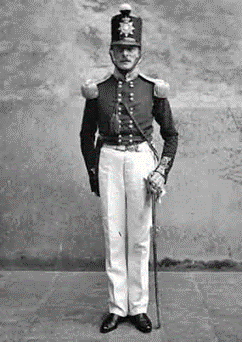
According to the 1851 Channel Island census, Frederick, now age 24, continues living with his mother, Esther, and two servants; one from Ireland and the other from France. His profession is listed as Captain in the 5th Regiment of the Royal Militia of the Island of Jersey. Formed in 1337, the Royal Jersey Militia is the oldest regiment in the British Army. The British Press Royal Jersey Almanac for the Year 1853 publishes all the commissions of officers in the Royal Militia of the Island of Jersey and states that on June 14, 1850, Frederick La Cloche Nicolle was commissioned a captain in the 5th or Southwest Regiment of the Royal Militia of the Island of Jersey. It also includes that on September 26, 1845, Frederick’s half-brother, Joshua John Le Touzel, was commissioned a captain in the 1st or Northwest Regiment, Field Battery in the Royal Artillery. The photo below models the uniform that was worn at the time.
Vraic Harvesting in Jersey
Vraic (pronounced vrak) is a form of seaweed found in the Channel Islands. Traditionally vraic was used as fertilizer for crops such as potatoes and also was dried and burned as fuel. In the 19th Century, when vraic was used extensively on the Island of Jersey, there were specific harvesting seasons. During these seasons, the collection of vraic was strictly regulated.
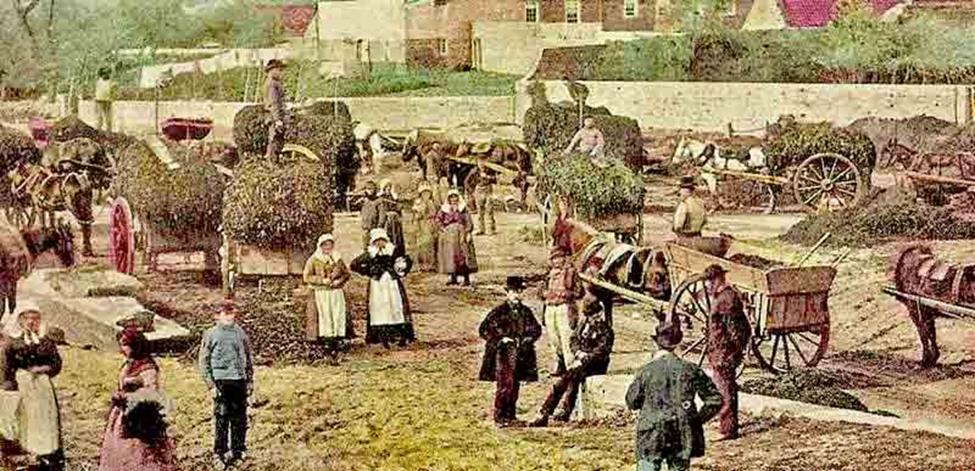
In 1848, two years before Frederick La Cloche Nicolle was commissioned as a Captain in the Royal Militia of the Island of Jersey, he was involved in a seemingly minor dispute in the Royal Court involving the ownership of some harvested vraic. A brief description of this court proceeding appeared in the Jersey Times. A transcription is shown below.
Transcription Jersey Times, 14 April to 9 May 1848
Royal Court
Tuesday 2 May 1848
Before E L Bisson, Lieut Bailiff, and Jurats Bertram and Le Couter
Mr Frederick La Cloche Nicolle has actioned Mr Edward Le Brocq to see himself condemned to pay the sum of £10 by way of damages for injuries done to the plaintiff on 19 March 1847 in taking some free loads of seaweed. The Court, after hearing witnesses, condemned the defendant to 12s damages and to the costs.
This is one of the few glimpses into the daily life of Frederick La Cloche Nicolle. Considering his family name, his commission in the RJIM, and his recorded description as a squire, he may have been a man of independent means but more revealing insight is needed. Perhaps vraic harvesting was one of his endeavors.
Neighborhood of Vingtaine du Coin Varin
These separate 1851 Channel Islands census records for Frederick and Margaret show that while they were not living together, they both lived in Vingtaine du Coin Varin, one of five vingtaines in the Parish of St. Peter. As described earlier, the French term vingtaine refers to a subdivision of about twenty households so their families certainly would have been neighbors. As related above, Frederick served as a witness for the wedding of Margaret’s eldest brother, John Hayes Strudwicke. Margaret was the second witness and signed her name as Margaret Nicolle. So, although Frederick and Margaret had three sons at this point, each recorded as born out of wedlock, it is possible that they did marry. Another fact to support this possibility is that each of their three sons who lived to adulthood were using the surname Nicolle as teenagers.
Family Tragedy
After the birth of their fourth son, Arthur Ernest, in April 1855, tragedy befell Frederick and Margaret and their family. Two months after being born in St. Brelade, Arthur, died of convulsions. Shortly thereafter, Margaret left Jersey for Southampton, England. While this was not near her birthplace of Croydon in Surrey, records show her brothers had married and started families there. Southampton is a port on the southern coast England with fairly easy access from Jersey by cross-channel steamer. It was here at 6 Union Terrace on January 9, 1856 that Margaret Elizabeth Strudwicke died. She was 31 years old. The cause of death was phthisis (tuberculosis). Selina Queen, her sister-in-law (brother Henry’s wife), was by her side. Her death certificate, shown here, referred to her as the daughter of Jeffrey Lambert Strudwicke, an annuitant, with no mention of Frederick La Cloche Nicolle.

With Margaret’s death, Frederick La Cloche Nicolle was left as a widower with three sons. If the boys living arrangement had remained as it had been on the 1851 census, they would be living with their grandparents, Jeffrey Lambert and Elizabeth Anne HAYES Strudwicke in the Vingtaine Le Coin Varin. In any event, on June 11, 1857, Captain Frederick La Cloche, RMIJ died. He was 30 years old. His death record in French, see below, described his profession as Ecuyer (Squire) and the cause of death as marasme which roughly translates to “wasting away.” Rather than a medical cause of death, marasme might be thought of as an underlying condition causing rapid weight loss which was a result of a more serious medical condition like cancer, tuberculosis, or any of the other extremely contagious diseases that were prevalent during the 19th Century. Given that Margaret Elizabeth Strudwicke died of pthisis (tuberculosis), it is quite possible that Frederick did as well but this can’t be said for certain.

The fact that Frederick and Margaret died so young is not so surprising for the time. The leading causes of death were tuberculosis, typhoid fever, diphtheria, and other infectious diseases. Infant mortality was about 20 percent and the overall life expectancy was 35 years. But, for those who survived into adulthood, the life expectancy increased dramatically with many inhabitants living to ripe old ages.
Having lost their mother and father in a little over a year, the brothers, Frederick, Alfred, and Francis were then orphans in 1857. They were ages 11, 9, and 7, respectively. At this point, it is not known if they were still living with their maternal grandparents, Jeffrey and Elizabeth Ann Strudwicke or if they received support from their paternal grandmother, Esther Nicolle who died the following year, 1858. The 1861 censuses in England and the Channel Islands show how the brothers were split up.
Nicolle Brothers’ Teenage Years
By 1861, Jeffrey Lambert and Elizabeth Ann Strudwicke, now ages 70 and 60, had returned to England and settled in Woking about 30 miles southwest of London. The 1861 England census recorded that their grandson, Frank Nicolle now age 11, was living with them and that he was working as a grocer’s errand boy. The first name Frank is a more English version of the French names Francis or Francois. Meanwhile, the 1861 Channel Islands census describe the brothers, Frederick Nicolle and Alfred Nicolle, then ages 15 and 13, living as servants in the home of General Charles R. W. Lane, Her Majesty’s Bengal Army. How the two brothers came to be employed by this General is unknown but perhaps the fact that their father was an officer in the Royal Militia of the Island of Jersey played a role.
To understand the brothers’ development from here, it is helpful to look at what options were available to the poor children especially orphans during the Victorian era. The worst-case scenario would to land in the poorhouse or a workhouse where living conditions and food were often meager and work assignments harsh. A more desirable situation would be to sign a contract as an indentured servant to a farmer, a tradesman, a storekeeper, or some other employer, who would take care of your basic needs of food, clothing, and shelter and in some cases monetary pay. There were cases of abuse of indentured servants but in many cases, it led to a better life. Perhaps a better alternative was to serve as an apprentice to a craftsman for an agreed upon number of years and have the opportunity to develop skills in that profession. One of Margaret’s brothers, Henry William Strudwicke is described as an apprentice shipwright in the 1851 Channel Islands census. A shipwright is essentially a carpenter on a ship. As Henry further developed his skills, he was listed as a carpenter ln a later census and after immigrating to New Jersey in the United States, he was described as a master carpenter. It is these types of opportunities that may help explain the paths of the three brothers.
So, when Margaret Elizabeth Strudwicke and Frederick La Cloche Nicolle died in 1856 and 1857, respectfully, their three sons, Frederick Nicolle, (Percy) Alfred Nicolle, and Frank Nicolle were confronted with immediate challenges for survival. They must have been thinking about how they might find meaningful employment and what the future may hold for them. Two things are intriguing about the brothers’ career paths which carried them forward in their lives. First, each brother was successful in training for a unique profession which in turn provided them with opportunities to be productive members of society. Second, the brothers set out in three different directions to three separate continents in search of a new life beyond the Isle of Jersey.
Three Career Paths
The 1860’s would have been the decade when the brothers, Frederick, Alfred, and Frank entered the workforce. It would be interesting to learn more about how they ultimately arrived at their job assignments but what is now known is that Frederick became a blacksmith, Alfred a police constable, and Frank a baker. Each of these professions was especially important to life during this time and each was well-respected and played a vital role in the community. However, these jobs during the Victorian period were extremely demanding, physical jobs with long hours. As time went on, each brother became successful and moved up the ladder and most importantly provided for their families and the next generation.
A Blacksmith
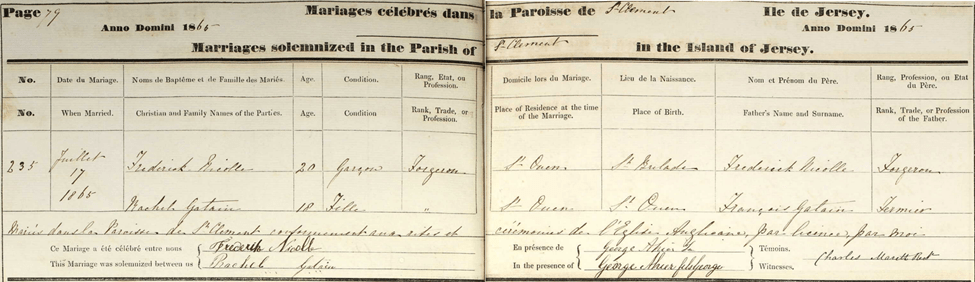
The eldest brother Frederick, my great great-grandfather, having acquired the skills of a blacksmith in Jersey, married Rachel Gatain in 1865. Rachel was the daughter of Francois Gatain, a farmer, and his wife, Rachel Cabot. Frederick and Rachel’s first child, Frederick John, was born in St. Ouen on the Island of Jersey in 1866 and this family of three is listed in the 1871 Channel Islands census. Around this time, they immigrated to Paspébiac, a remote fishing outpost on the Gaspé Peninsula of Quebec. According to the 1881 Quebec census both Frederick, age 35, and his son Frederick John, age 15, were blacksmiths. A catalogue of blacksmiths in the region at the time describes the two of them working together in the father’s forge.
A Police Constable
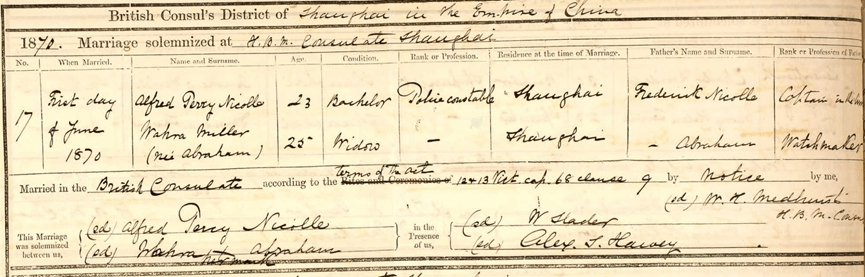
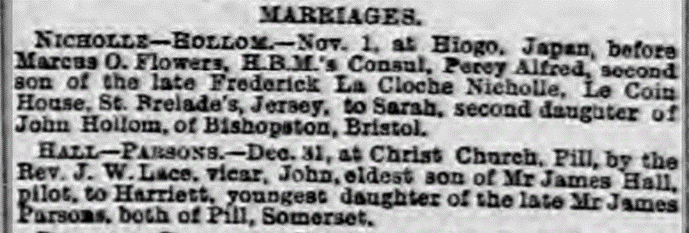
The second brother Alfred (sometimes Percy Alfred) went off in a completely different direction. He became a police constable and is shown to have first worked in Shanghai, China and then was recruited to come to Kobe, Japan to help develop a modern police force there. Alfred’s uncle, Montague Johnson Strudwicke, also was a police constable and perhaps was a role model for his nephew.
Below are two graphics describing Alfred’s father. The Shanghai record for his first marriage describes his father as Frederick Nicolle who is a Captain in the Army. The newspaper announcement for his second marriage details that he is the second son of Frederick La Cloche Nicolle of Le Coin House in St. Brelade’s, Jersey.
A Baker
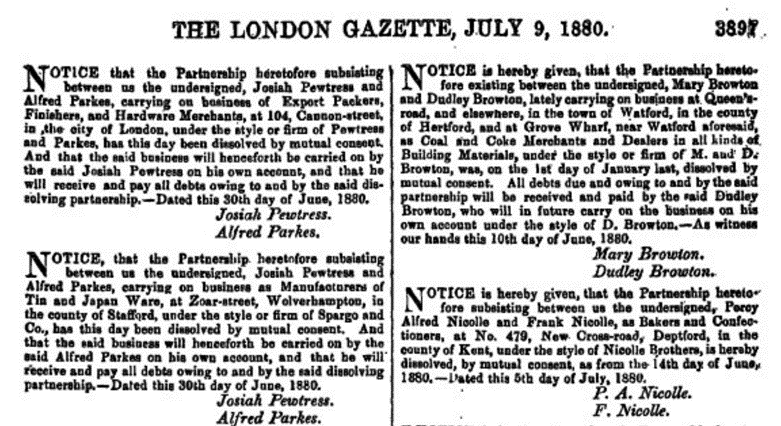
The third brother, Francis (Frank) settled closer to Jersey in England and became a baker. Frank married Emma Huddlestone in 1872. Emma’s father, Charles Huddlestone also was a baker. A newspaper article from 1879 details that brothers Alfred and Frank had a joint business venture called Nicolle Brothers Bakery that was being dissolved. Alfred had returned from Japan to England briefly at this time.
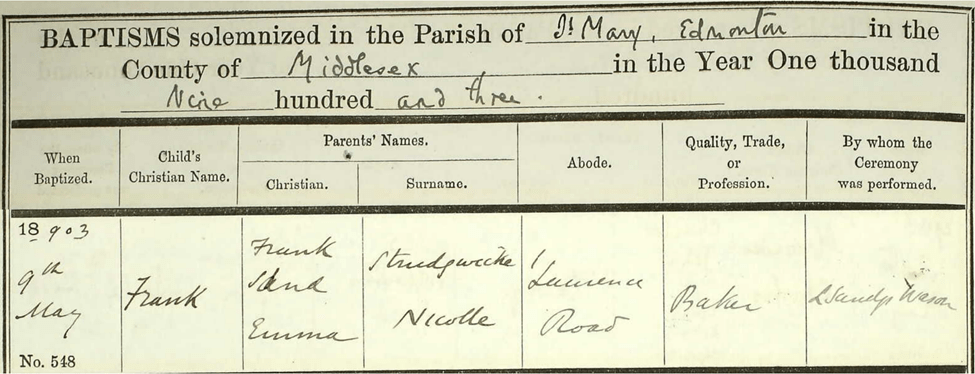
There is a curious question regarding Frank’s change of surname. After being born Francis Lambert, he then used the name Francis (Frank) Nicolle as a teenager and into adulthood. At some point, Frank Nicolle transitioned to being referred to as Frank Strudwicke. The record below details the birth of Frank and Emma’s youngest child, a son, Frank Strudwicke. Note that the father’s name is Frank Strudwicke and the mother’s name is Emma Nicolle. So, in 1903, Frank had changed his name to Strudwicke while his wife, Emma, had retained her married name of Nicolle. Actually, Frank’s name change may have happened earlier as only his eldest child Louisa Margaret was born with the surname Nicolle. The five later children were named Strudwicke at birth and Louisa Margaret eventually changed her name to Strudwicke as well. By comparing birth, marriage, and census records, Frank’s name change happened in the early 1880’s.
Final Years of the Nicolle Brothers
Frank died in 1911 at 60 years of age in Edmonton, England. His death record notes his name as Frank Strudwicke. Twelve years earlier in 1899 on a voyage from Japan to England, Alfred died at sea. The cause of death was documented as stomach cancer. Frederick and his wife Rachel died with weeks of each other in 1921 in Bathurst, New Brunswick. He was 75 and she was 72. A table of vital statistics for the three brothers, Frederick, (Percy) Alfred, and Francis (Frank) is given below.
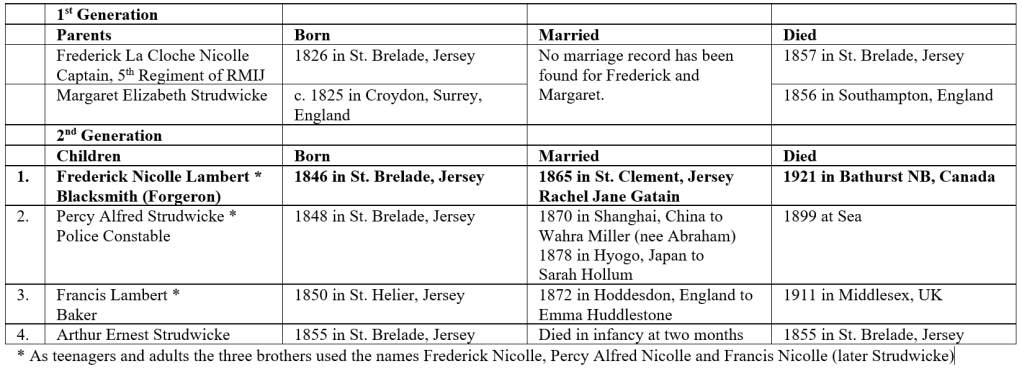
Grandchildren of Frederick & Margaret
Each of the three brothers married and raised a number of children. So, by the late 19th Century Frederick La Cloche Nicolle and Margaret Elizabeth Strudwicke had nineteen grandchildren born in various locations including Jersey, Quebec, Japan, and England. All are shown in the table below. Multiplying for subsequent generations, Frederick and Margaret would have several hundred descendants today.

New Life in Quebec, Canada
A question remains as to when Frederick and Rachel initially arrived in Quebec. On the 1921 Canada Census, Frederick (then age 75 and shortly before his death) lists his date of immigration as 1867. Other census records show him immigrating to Canada in other years. Similarly, Rachel has 1872 and 1878 as possible years she may have entered Canada. Since the 1871 Channel Islands Census shows Rachel and Frederick living in Jersey with their young son Frederick John, the 1867 entry could be a mistake or it is possible that Frederick immigrated around 1867 to set up the family’s move to Quebec and then returned to Jersey to bring his family over. It is even possible that Frederick immigrated first and Rachel and their son followed later. In any event, the fact that their first of seven children, Frederick John, was born in 1866 in Jersey and their second child, Francis, was born eight years later in 1874 in Quebec might suggest that the couple was apart during part of this period.
A check of the passenger lists for vessels traveling from Liverpool to Quebec City, the most popular route during this period, does include several blacksmiths as well as immigrants with names and ages similar to Frederick, Rachel and their young son. However, there does not appear to be a solid match describing them in order to definitely identify the vessel they took and their exact date and port of arrival. During this period, immigrants from England and Ireland booked passage on passenger steamers that took roughly ten days to cross the Atlantic. Having been unsuccessful in identifying the ship or ships that brought Frederick, Rachel and their young son to Canada, one possible vessel was the S.S. Nestorian, shown below, of the Allan Line. This steamship made four or five voyages a year from May to October. The 1872 voyage the departed Liverpool on September 12, stopped in Londonderry, and arrived in Quebec City on September 23 is a possible candidate.
For a brief history of these immigrants who ventured from the Channel Islands to the Gaspé Peninsula see, The Anglo-Normans in Eastern Canada by Yves Frenette and translated by Carole Dolan.

The Jersey and Gaspé Connection
Another interesting question is why Frederick Nicolle would have decided to emigrate in the first place from the relaxed atmosphere and comfortable climate of Jersey to the somewhat primitive environment of the Gaspé Peninsula with its severe winters. As is the case with many immigrants, Frederick may have simply been searching for a new life and new environment where he and his wife could raise their family. His specific choice of Paspébiac may have been rooted in a historic connection between the Isle of Jersey and the Gaspé Peninsula and a job offer with the Charles Robin Company headquartered there.
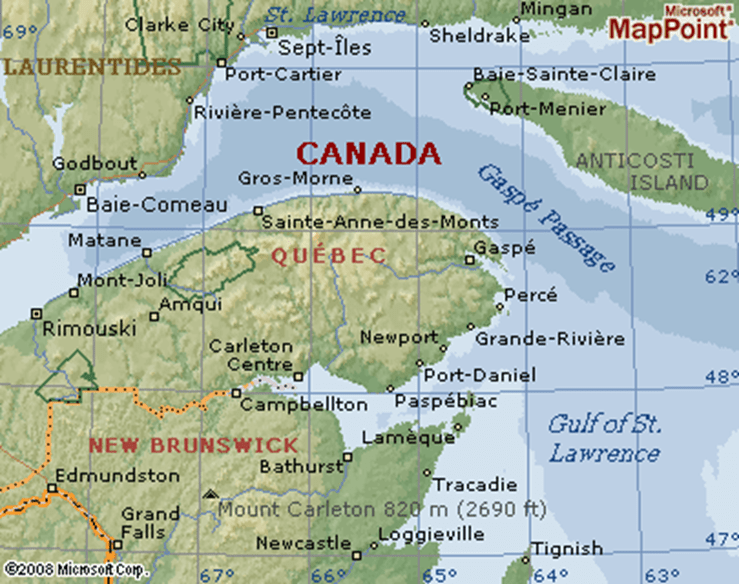
In 1766, one hundred years before Frederick and Rachel’s arrival, an entrepreneur and Jersey native, Charles Robin, journeyed up the Gulf of St. Lawrence to the remote shores of the Gaspé Peninsula. He was instrumental in developing the process of drying and preserving cod for export to the West Indies, South America, and Europe in a triangle arrangement with cod being exported from Quebec to the West Indies where sugar cane and rum were traded for shipment to England, Spain and Portugal. Completing the triangle England sent manufactured goods back to the Gaspé Peninsula.
For more on the life of Charles Robin see From Jersey to the Gaspé: Charles Robin, 1743-1824, A Forgotten Father of Canada (Part 1).

Life in Cod Fishing Ports of Paspébiac and Percé
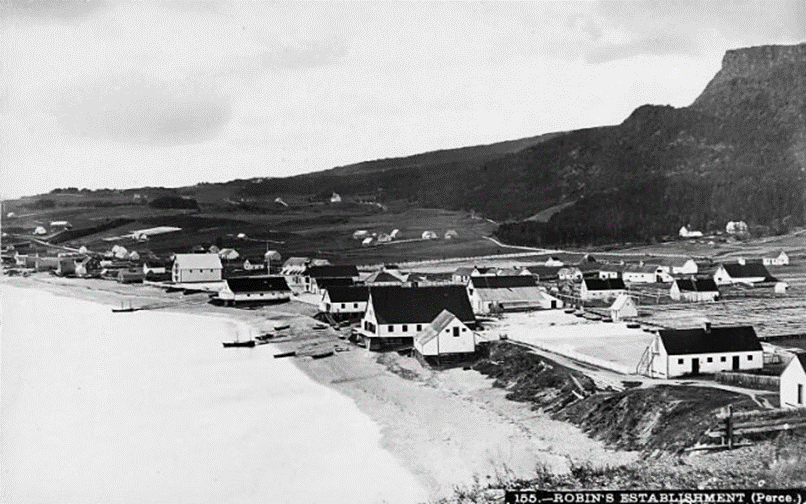
The 1881 Canada census has Frederick and Rachel and their first four children residing in Paspébiac where Frederick was employed as a forgeron (blacksmith) by the Charles Robin Company. His eldest son, Frederick John then 15, was also listed as a blacksmith. The year 1886 proved to be catastrophic for the region as the Jersey Banking Company went bankrupt which in turn caused the Charles Robin Company to be driven into bankruptcy as well. Since the people of Paspébiac were unable to secure their usual supplies, several groups raided the warehouses in what is known as the Paspébiac riots of 1886. Frederick and Rachel were most likely there as their youngest child Percy was born in Paspébiac in February 1887. These degenerating conditions may explain why Frederick and Rachel might have decided to move their family from Paspébiac to Percé some 70 miles up the coast of the Gaspé Peninsula. As Frederick’s profession of blacksmith was needed up and down the coast, he most likely transferred to Charles Robin’s Establishment in Percé.
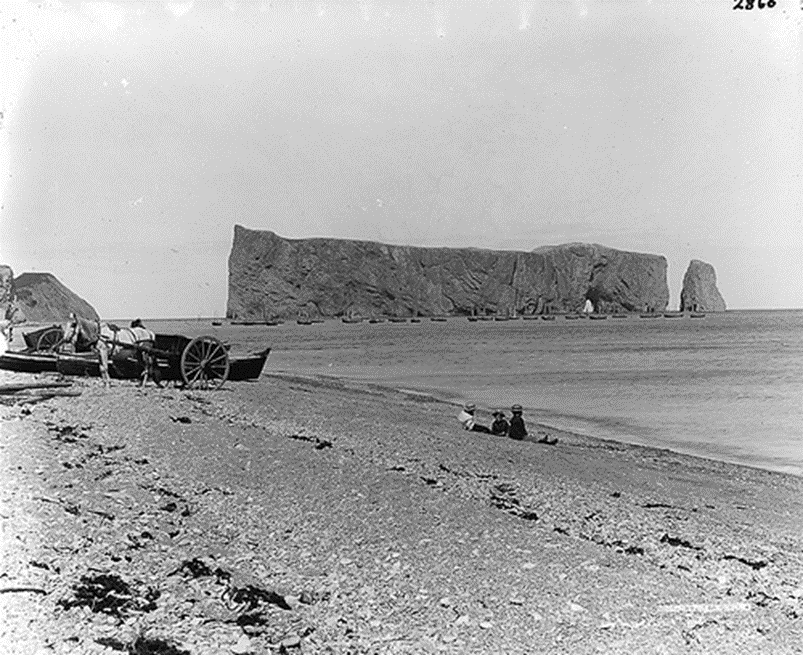
The 1891 census shows Frederick and Rachel and six of their seven children living in Percé. Their eldest child, Frederick John who was 25 at this time is not listed. In 1894, their youngest son Percy, age 7, died in Percé and is buried at St Paul’s Anglican Church and Cemetery in Cape Cove, Quebec. The two photos below are from the Notman Photographic Archives and show the beach and village at Percé in the 1890’s around the time Frederick and Rachel and their family lived there. The name Percé originates with the explorer, Samuel de Champlain, who visited the area in 1603 and named the famous rock in French, Isle Percée, or Pierced Island. Today Percé is designated as one of the most beautiful villages in Quebec.
First Three Children Are Sons and All Blacksmiths
Frederick and Rachel had seven children. As described above, their first child, Frederick John, was born on the Isle of Jersey with their remaining children born in Paspébiac, Quebec. Their first three children were sons, Frederick, Francis (Frank), and Alfred, who apparently were named after their father and his two brothers’ Frederick, Percy Alfred, and Francis. It is possible however, that Rachel’s father who also was named François (Francis) could have been a source for Frank’s name as well. All three brothers followed their father into the blacksmith trade and each eventually departed Quebec with Frederick John settling in Amherst, Nova Scotia, Frank in Minneapolis, Minnesota, and Alfred in Bathurst, New Brunswick. In the late 19th Century as the world transitioned from horse-driven modes of production and transportation to the mechanized modern world, the services of blacksmiths were not so much in demand. The census records of the time show the brothers working as mechanics, boilermakers and other opportunities where they could adapt their blacksmith skills for 20th Century jobs.
Three Daughters
Frederick and Rachel’s next three children were daughters, Sarah Ann, Alinda (Elinda), and Lydia born in Paspébiac and lived some of their formative years in Percé, near the tip of the Gaspé Peninsula. At some point in the 1890’s, the family moved from Percé across the Chaleur Bay to take up residence in the small port city of Bathurst, New Brunswick. It was there that each of the sisters married and settled in and around Bathurst.
The first of the sisters to marry was Sarah who married Henry Whittom on Christmas Day, 1899. Witnesses at their marriage in Bathurst were Alfred Nicolle, Sarah’s brother, and A.S. Gatain who was likely Rachel’s nephew, Arthur Stanley Gatain. This would confirm that members of Rachel’s side of the family (Gatain) resided in Bathurst as well. In fact, the Gatain’s appear to have been established in Bathurst before the Nicolle’s arrived. Also, Henry Whittom’s younger sister, Emma, was the wife of Frank Nicolle. This is not surprising as the Whittom’s and the Nicolle’s were life-long friends growing up together in Paspébiac. The following year 1900, tragedy struck the family again when Sarah’s husband, Henry, died of pneumonia after just five months of marriage. The 1901 Canada census finds Frederick and Rachel living with their three daughters Sarah, Alinda, and Lydia in Bathurst with the oldest, Sarah, now age 21, described as a widow.
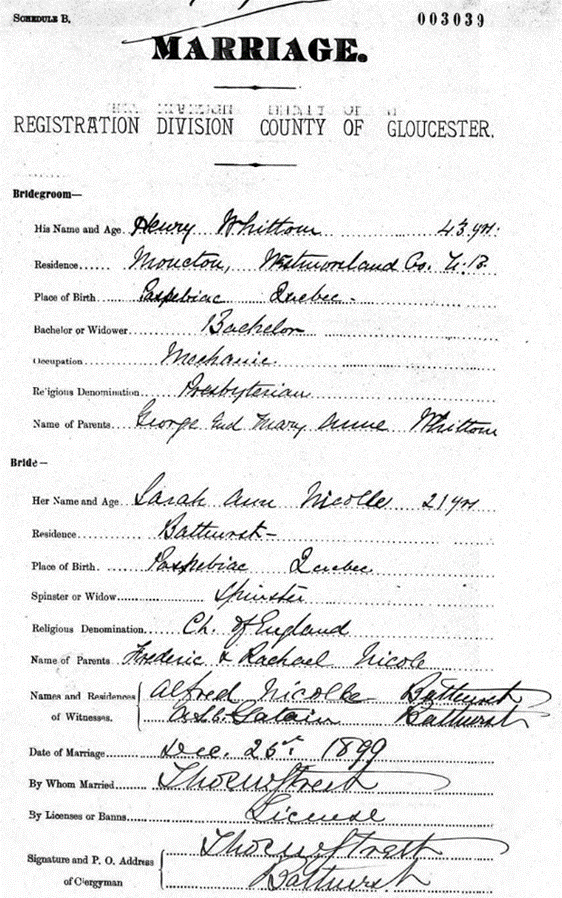
Family Moves to Nova Scotia and New Brunswick
The 1911 Canada census shows Frederick and Rachel living in Amherst, Nova Scotia with their son Alfred, a life-long bachelor, and daughter Sarah. Amherst was where Frederick and Rachel’s eldest son, Frederick John, had married and was raising a family. Over the course of these years, all three daughters married including Sarah who remarried in 1917. Her husband Valentine Barlow Crossman was an iron moulder in Amherst. Eventually Frederick and Rachel moved back to Bathurst.
Frederick and Rachel both died in Bathurst in 1921; Rachel in April and Frederick a few weeks later in June and are buried in St. George’s Cemetery, West Bathurst. They had been living at the home of their daughter, Lydia, and son-in-law, Ernest Branch. The 1921 Canada census describes Frederick and his son Alfred, Lydia’s brother, as lodgers in Ernest and Lydia’s home with Frederick described as a widower and Alfred as single and a blacksmith.
Throughout his life as a blacksmith from Jersey to Quebec and later to New Brunswick and Nova Scotia, Frederick, the elder blacksmith, and his children always used the family name Nicolle. On Frederick’s 1921 death record in Bathurst, New Brunswick, his occupation was listed as blacksmith. More importantly, his father’s name is entered as Frederick Nicolle and his mother’s maiden name as Elizabeth Strudwicke. This record also included that Frederick and both his parents were born on Island of Jersey. This adds another vital source helping substantiate that Frederick’s parents were indeed Frederick La Cloche Nicolle and Margaret Elizabeth Strudwicke.

Turn of the Century in Amherst
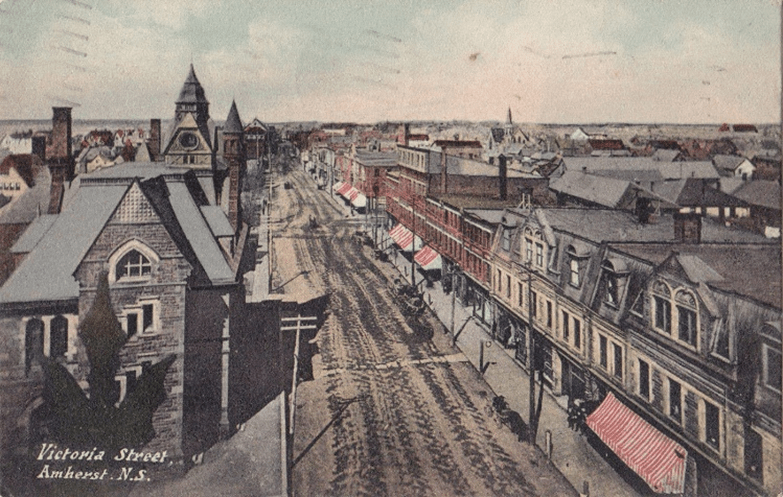
Our story continues with the next generation and Frederick and Rachel’s eldest child, Frederick John, my great grandfather, who was born in 1866 in Jersey and then immigrated with his family to Canada shortly thereafter. As described above, he appears in in the 1881 Canada census at age 15 working as a blacksmith and living with his parents, two brothers, and a sister in Paspébiac, Quebec. Ten years later, he is not listed with the family on the 1891 census in Percé QC and presumably living on his own. In 1902, Frederick John Nicolle married Margaret Ellen Brownell in Amherst, Nova Scotia. Margaret Ellen was the daughter of Ephraim Dixon Brownell, a farmer, and Authalinda Eliza Jane (Reid) Brownell from Shinimicas, Cumberland County about twenty miles east of Amherst. The Brownell and Reid families lived for several generations in the area of Shinimicas and Northport NS and nearby New Brunswick. Both families emigrated from New England around the time of the American Revolution. In the marriage documentation below, Frederick John’s middle name is incorrectly recorded as Joseph.

In the 1911 Canada census, Frederick, a blacksmith by trade, is described as a laborer working at the Amherst Car Works which produced complete passenger and freight railway cars and also had a rolling mill and axle plant. At the beginning of World War I, the Amherst Car Works covered an area of forty acres, employed over 1,500 men, and turned out six complete railway cars every working day.
Railway Age
Over the years, different types of railway cars were produced in Amherst including wooden passenger cars like the historic car, Alexandra, shown below, built in 1905 by the Rhodes Curry Company. This most elegant car was made for Canadian Governor General Earl Gray and used by several Prime Ministers. The car was named in honor of Queen Alexandra (1844-1925) Consort of King Edward VII. The car can be seen at the Train Station Inn in Tatamagouche.

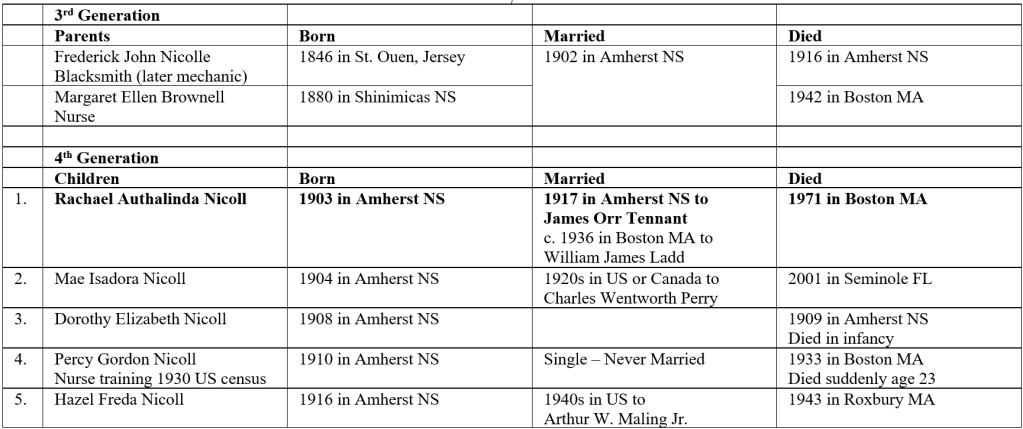
Frederick John and Margaret Ellen lived for several years at 43 York Street in Amherst and raised their family which included five children. In 1916, their fifth child Hazel Freda was born a few months after Frederick’s untimely death at age 49. In 1917, their eldest daughter, Rachel Authalinda married James Orr Tennant who had emigrated from Glasgow, Scotland in 1913. The groom was 22 years old and the bride 14. On his draft notice for World War I, James’ occupation is listed as a rolling mill iron worker so he may have worked alongside his father-in-law Frederick in the Amherst Car Works. After their marriage, James and Rachel, my grandparents, moved in with Rachel’s mother, Margaret, and siblings Mae, Percy, and Hazel. Another sister, Dorothy Elizabeth, had died in infancy. The 1921 Canada census lists the combined Tennant and Nicolle families residing at 43 York Street along with James and Rachel’s baby, Frederick Ferguson. This census also shows that James is out of work from the rolling mill as this was a period of a deepening recession in Amherst.
Decline of Amherst
After World War I, Amherst’s economy along with numerous cities and towns in the Maritime Provinces declined as the government of Canada focused more on the central provinces and British Columbia. The Great Amherst General Strike in 1919 affected the railway car industry in particular. These government policies and labor issues caused thousands of people in the 1920s to leave Amherst in search of employment and new lives in Western Canada and New England.

New Life in Boston
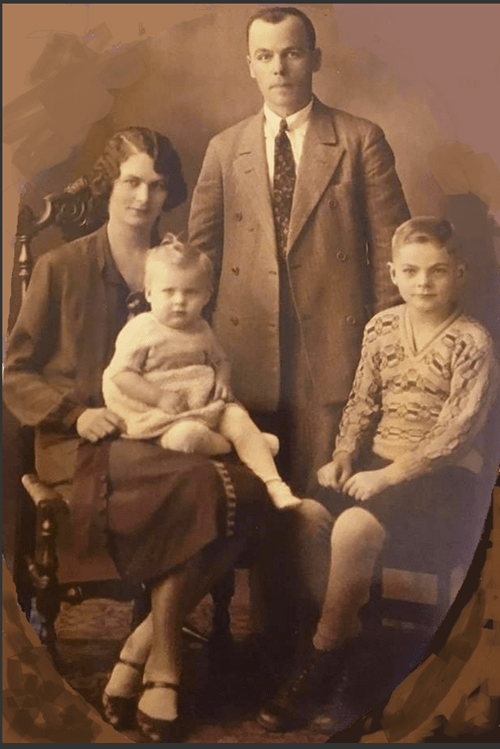
Between 1924 and 1926, Margaret Ellen (Brownell) Nicolle oversaw the family’s exodus from Amherst, Nova Scotia. This included herself, her four surviving children, Rachel Authalinda, Mae Isadora, Percy Gordon, and Hazel Freda along with Rachel’s husband James Orr Tennant and their two children Frederick Ferguson and Margaret Isabelle who was born in Amherst in 1926. The entire family immigrated to the United States settling in Boston, Massachusetts.
Returning to America
Arriving in Boston, the families were actually returning to ancestral roots in Massachusetts perhaps unknown to them. Further out on the family tree from Frederick John Nicolle and Margaret Ellen Brownell along the Brownell, Reid, and Allen branches, you find an ancestor, Samuel Allen, had crossed the Atlantic from Bridgewater, England to Massachusetts around 1630. This was not too long after the Mayflower had landed at Plymouth Rock in 1620. His son, Deacon Samuel Allen, was born in 1632 in Braintree then a part of the Massachusetts Bay Colony. At the time of the American Revolution several members of the Allen family relocated to New Brunswick and Nova Scotia which connects with our current story. This account of the Allen family in colonial times has yet to be told.
Meanwhile, in 1930, James and Rachel along with Frederick, and Margaret lived at 6 Dana Place in Suffolk County, Boston. Rachel’s mother, Margaret Ellen Nicolle and two of her children, Percy and Hazel, lived next door at 4 Dana Place. James was working as a candy maker in a factory and Margaret Ellen was working as a nurse in private homes. Percy, then age 19, was enrolled in nurse’s training and worked at Massachusetts General Hospital. The 1930 census, below, shows the four members of the Tennant family and the three members of the Nicolle family as neighbors. An interesting question on the census asks, Is a there a radio set in the home?” The Tennant family had a radio and the Nicolle family did not. Later that census year, James and Rachel’s third child, James Roger, was born in October, 1930.

Mae Isadora, who had been the first in the family to leave Amherst arrived in Boston in 1924 and shortly thereafter married Charles Perry, a milk wagon driver. By 1930, Charles and Mae lived at 96 Gibson Street in Dorchester with their two sons, Franklin, age 4, and Charles, age 2. By 1935, they had moved to Abington MA a town about 20 miles southeast of Boston in Plymouth County where Charles acquired a working dairy farm.
At some point after 1930, James Orr Tennant and Rachel divorced but remained close throughout their lives. In 1936, Rachel married William James Ladd and they had one son William Percy Ladd born in 1937. Around this time, they bought a house at 22 Wyoming Street in Roxbury MA where the family lived for many years.
The Depression and World War II
The 1940 US census describes Charles and Mae (Nicolle) Perry living in their own house on 286 Lincoln St, the site of Charles’ dairy farm along with their three children Franklin, Charles, and Dorothy. Mae’s mother, Margaret Ellen Nicolle, bought a house in the neighborhood at 363 Lincoln St and was living with her daughter Hazel Freda. Margaret’s only son, Percy Gordon, had died suddenly in 1933 at age 23. Throughout the Depression and World War II, Rachel’s family, Mae’s family, mother Margaret and Hazel Freda relied on each other as they set down roots in the US and raised their families. In 1943, Hazel died in Roxbury.
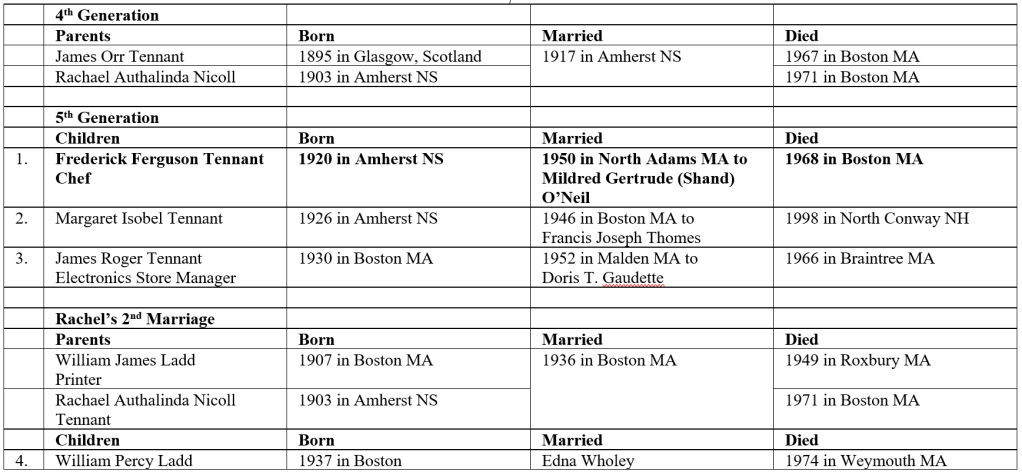
James Orr Tennant died in 1967 and Rachel Authalinda (Nicolle) Tennant Ladd died in 1971. Rachel’s three sons, Frederick Ferguson Tennant, James Roger Tennant, and William Percy Ladd each died in separate accidents around Boston during an eight-year period in the late 1960s and early 1970s. Their sister, Margaret Isabelle (Tennant) Thomes Sandiford Juliano died in 1998 at age 72.
Arriving at the 20th Century Generation
Frederick Ferguson Tennant, my father, eldest child of James Orr Tennant and Rachel Authalinda Nicolle, was born in Amherst, Nova Scotia in 1920. After his family immigrated to Boston in 1926, he grew up in Roxbury MA. In 1935, he graduated from the Dwight School in Boston. In 1941, he is described on his US World War II Draft Card for Young Men as a farmer residing in North Abington MA at 363 Lincoln St, the home of his grandmother, Margaret Ellen Nicolle. Still a Canadian citizen, he returned to Canada during World War II and worked as a C.N.R. Constable for the Canadian National Railways. In the late 1940’s, Frederick met Mildred (Shand) O’Neil in western Massachusetts. Mildred and her sisters had immigrated to Pittsfield MA in 1926 the same year that Frederick and his family immigrated to Boston. Coincidentally, Frederick and Mildred were both born in Amherst, Nova Scotia and their families left there in the same year, 1926, perhaps due to the employment crisis and economic conditions described above. In 1950, Frederick and Mildred were married and settled in North Adams MA where they had one son, Raymond Frederick Tennant. In 1959, Frederick became a naturalized U.S. citizen. Later in life, he worked as a professional chef at various institutions around New England including Pine Manor Junior College (no longer located in Wellesley)Pine Manor Junior College in Wellesley MA and Morgan Memorial Goodwill Industries in Boston. He died in 1968.

First Names
Genealogy branches are usually researched by surnames but sometimes first names can reveal patterns as well, especially in branches like this one where each descendant in the line is the firstborn of their family. The common practice of naming first and second born children after grandparents or parents is evident in this branch of our family. The name Frederick appears throughout these direct descendants and the name Rachel is passed down as well. The three brothers, Frederick, Percy Alfred, and Francis, who ventured from Jersey to places around the world, had their names live on in their descendants. In addition, at least two of Percy Alfred’s progenies were given the middle name of La Cloche lending additional circumstantial evidence to support Frederick La Cloche Nicolle’s ancestral place in this story. And finally, the name Frederick appears once again as the middle name of the author.
Eight Generations
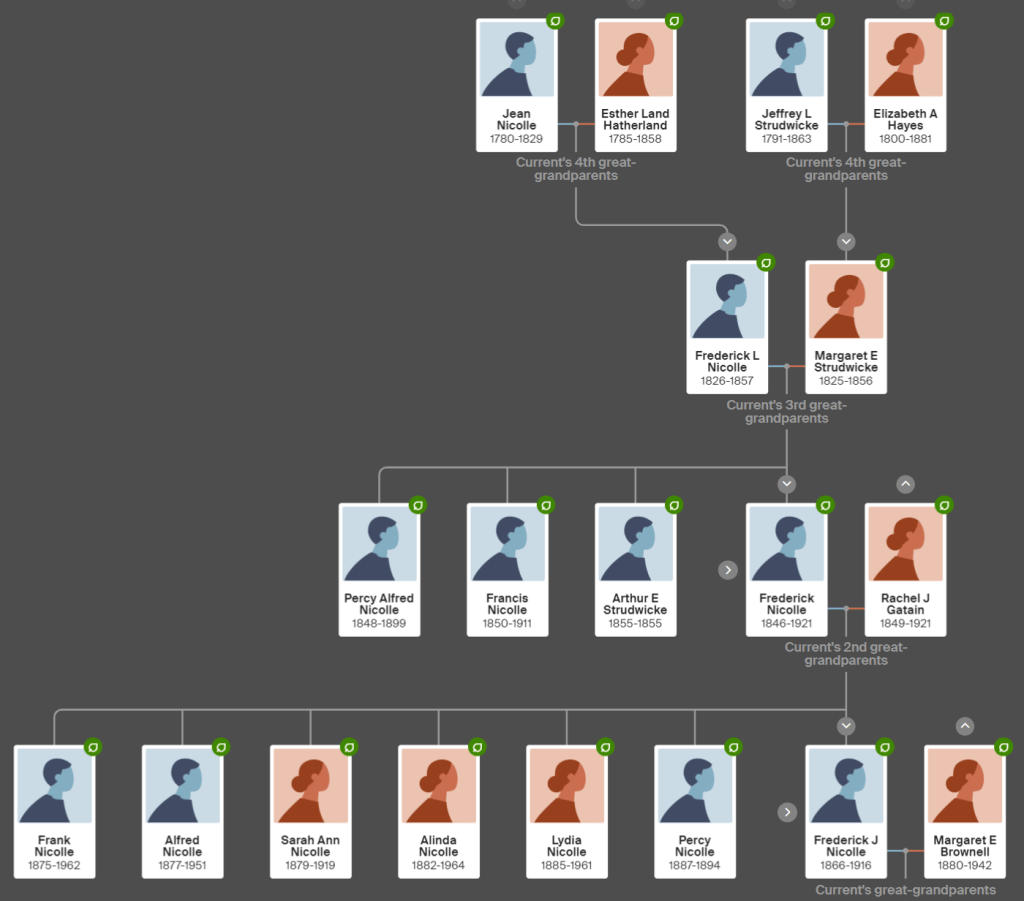
To help with making sense of this story, a portion of our Ancestry Family Tree is shown below highlighting eight generations of this branch of our tree. The top half begins with the parents of Captain Frederick La Cloche Nicolle and Margaret Elizabeth Strudwicke and the bottom half ends with the current and next generations. All brothers and sisters of our family’s direct ancestors along this branch have been added to the tree. Thus, anyone with an ancestor in this tree is easily identified as a direct descendant of this ancestral story with roots in the Isle of Jersey and England. More details can be found on our more comprehensive family tree on the Ancestry site.

Final Thought
Finally, this story takes us to the current generation on this ancestral path from the Isle of Jersey to the Provinces of Quebec, New Brunswick, and Nova Scotia, and finally to the City of Boston and its environs. Well, not finally, as the present generation now resides in Virginia and the story will continue from here. And so does our research. Currently, we are studying the Allen branch mentioned above, from their early days as founding families in 17th Century Boston to their experiences during the American Revolution. We’ll add a new chapter when we have more of the story to tell!
Respectfully,
Raymond Frederick Tennant
(Captain Frederick and Margaret Elizabeth’s great-great-great-grandson)
March 2022
 Tennant, Shand, Nicolle, Allen Ancestor Stories