
The Journey of Alexander and Jane (Forrest) Shand
Scotland to Canada
The story of this incredible journey begins in Tyrie, Aberdeenshire, Scotland and ends in Black Point, Queens County, Nova Scotia, Canada. These two places appear in the zoomed-in maps in the right column. See if you can locate them. Hint: Tyrie is near Fraserburgh and Black Point is on the coast near Liverpool.
Maps

This is the story of my great-great-grandparents Alexander Shand and Jane Forrest who hailed from the County of Aberdeenshire in Northeast Scotland. Alexander and Jane are ancestors on my mother’s side of the family tree. Here’s how to describe the lineage back to Alexander. My mother’s maiden name was Mildred Gertrude Shand (1911-1976) and she was born in Amherst, Nova Scotia. Her father, John Steadman Shand (1876-1957), and grandfather, Paul Fraser Shand (1841-1916) were both born in Queens County, Nova Scotia. Mildred’s great-grandfather, Alexander Shand (1810-1897), was born in Scotland and is the progenitor of our family’s Shand relatives in Canada. Alexander and his first wife, Jane Forrest (1813-1881) are my great-great-grandparents. This story attempts to fill in a few details of Alexander and Jane’s lives as they left their farm in Tyrie and sailed across the Atlantic to settle near Liverpool, Nova Scotia and raise their twelve children.
We began our investigation gathering information from Alexander and Jane’s deaths and working backwards. In the Old Trinity Anglican Cemetery in Liverpool, Nova Scotia Cemetery, a tombstone for Jane has the following inscription:
ERECTED BY the Father & sons to the MEMORY of JANE FOREST native of Aberdeenshire beloved wife of ALEXANDER SHAND Died July 29, 1881 Aged 68 years
This would mean Jane Forrest (also referred to as Jeanne Forrest) was born about 1813. There is some speculation that she was born in Ellon, a small town about sixteen miles north of Aberdeen.
A tombstone for Alexander Shand has not been located but his death was recorded in a family bible possessed by his granddaughter, Marion Letitia Smith, of Black Point, NS. Marion was the daughter of Mary Ellen (Shand) Smith who was the sixth child of Alexander and Jane and the last to be born in Scotland. In this family bible, the following events were recorded:
- Alexander Shand, born in Scotland, was the first of his name in Queens County, NS.
- Jean Forrest, the beloved wife of Alex Shand, died July 29, 1881 (Easter Sunday morning).
- Alexander Shand (Senior) married a second time to Julia Lowe, September 25, 1884.
- Alexander Shand died in Black Point on April 18, 1897, aged 87 years and 2 months.
- Julia Lowe died in Liverpool, NS on November 1, 1903, aged 73 years.
This entry that Alexander Shand was 87 years and 2 months old when he died would mean he was born about February 1810. Looking at birth records around Northeast Scotland, one finds an Alexander Shand born about this time in Cabrach in the nearby county of Moray. This Alexander’s parents were Alexander Shand and Margaret Riach. On close inspection of the 1884 Queens County marriage record (see below) for Alexander Shand’s second marriage to Julia Lowe, revealed that his parents were James and Elizabeth Shand. James’ occupation was described as a farmer. On Scottish records, Elizabeth is often referred to by the Scottish variant Elspet. So, at least at this point in time, no birth record for our ancestor, Alexander Shand, has been found.

Looking back further using James Shand’s 1863 Death Record shows his parents were George Shand and Christian Grant with George described as a farmer. Thus, at least three generations of Shand men can be traced back, namely Alexander, his father James, and his grandfather George as farmers living in the County of Aberdeenshire, in Northeast Scotland.
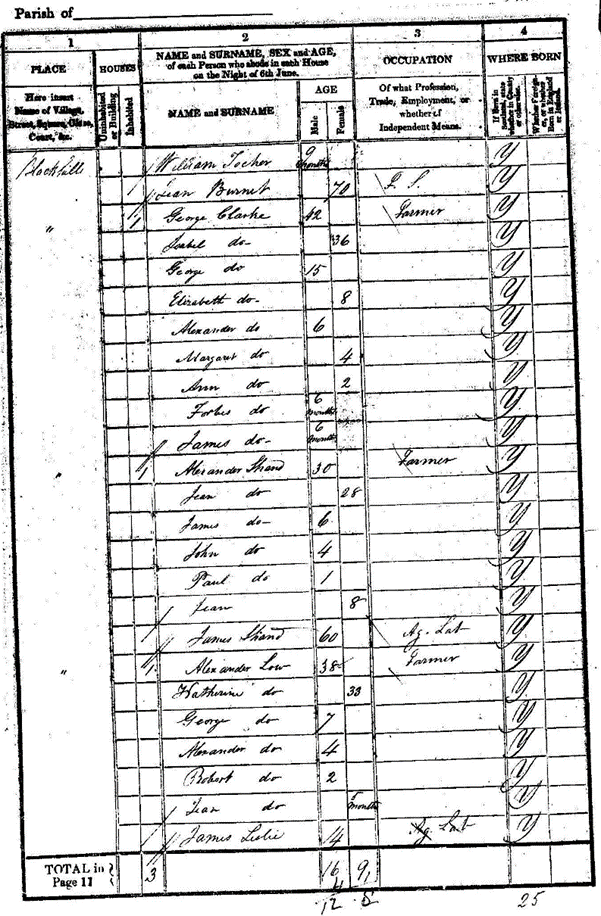
1841 Scotland Census
On the 1841 Scotland census (below), Alexander Shand is a farmer living in an area known as Blackhills, parish of Tyrie, Aberdeenshire. His wife Jean (Jane) is with him along with their first four children; Jean (age 8), James (age 6), John (age 4), and Paul (age 1). The baby Paul is my great-grandfather. Alexander’s father, James Shand (age 60), is also living with the family although he is not listed as his father but rather as an agricultural laborer. As mentioned above, Alexander’s father and grandfather were also farmers and appear to have been tied to the land around Tyrie. Alexander’s mother, Elspet (Roy) Shand, who would be about age 47, is not listed in this 1841 census. Since Elspet is shown living with James on the 1851 and 1861 Scotland censuses (see below), there may be some logical explanation for her name not appearing on this 1841 census.

Decision to Leave Tyrie and Scotland
To better understand the lives Alexander Shand and his family, one needs to consider the history of Scotland in the 1840s and the overall Scottish Diaspora which saw Scots emigrate in large numbers around the world. This was the time of the Irish Potato Famine which caused almost two million Irish to leave their homes with several hundred thousand coming to the United States and Canada in search of new lives. The Great Famine also affected Scotland but not to the same extent as potatoes were not the sole staple in the Scottish diet. There was another reason however for Scots to seek new horizons in North America, particularly Canada. This problem involved opportunities to own land and the ability to earn a living as a farmer and this may have been the motivation for Alexander and Jane Shand.
Crofters
During the 1840’s as well as before and into the 20th Century, virtually all farms in Scotland were worked by tenant farmers who rented the land from large landowners which included noble families, bodies like the National Trust, or the Crown. The leases for small farms called crofts usually were for a period of 19-years or some agreed upon fraction of time. Crofters, like Alexander, faced uphill challenges to make ends meet during these times. First, it was difficult to earn a living and support a growing family with what could be produced on a small farm. Second, the landowners found that combining smaller crofts into larger ones was more cost efficient and also that other uses for the land besides farming were more profitable like raising sheep or even hunting deer. Many crofters were forcibly evicted from their land during this period called the Highland Clearances in some locales.
Besides these negative factors driving crofters from their homes in Aberdeenshire there were positive factors as well. Many Scots who had settled in Canada in the earlier part of the 19th Century had written home telling of wonderful opportunities for Scottish immigrants in Canada. Some of these testimonials were even published in the newspapers to encourage emigration. So, it was well known that there were opportunities across the ocean to own land, to make a successful living, to participate in the development of a new and vibrant country, and to accomplish one’s dreams. We do know that Alexander and Jane knew earlier settlers so this may have made their decision to leave much easier.
Alexander and Jane’s Croft in Tyrie
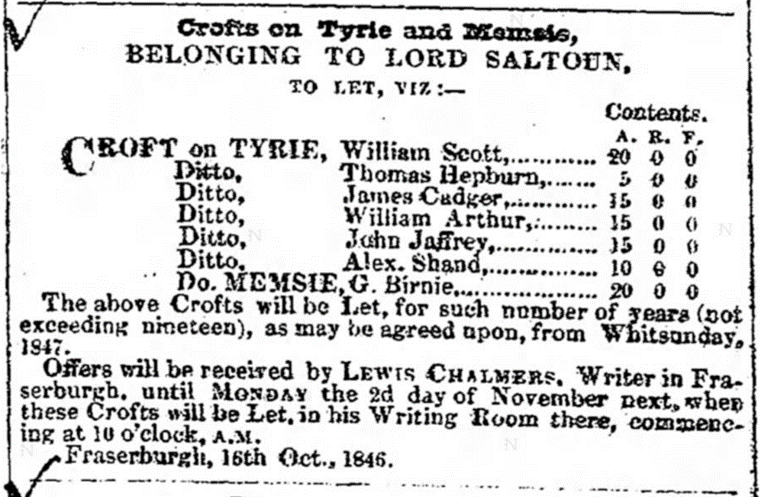
Alexander and Jane Shand rented a small farm called a croft in the hamlet of Tyrie. The main landowner in the area around Fraserburgh, including Tyrie and Memsie, was Lord Saltoun of Philorth. It is difficult to say what specific challenges Alexander faced in working his croft. Also, it is not known what plans Lord Saltoun might have had for the crofts in Tyrie. In any event, the following notice appeared in the Aberdeen Journal on October 21 and October 28, 1846 which shows Alexander’s 10-acre croft will be offered for lease to a new crofter beginning in 1847. The notice shows the new tenant’s contract would take effect on Whitsunday, the 50th day of Easter, when such transactions typically took place. In 1847, Whitsunday was May 23.
Emigration from Scotland
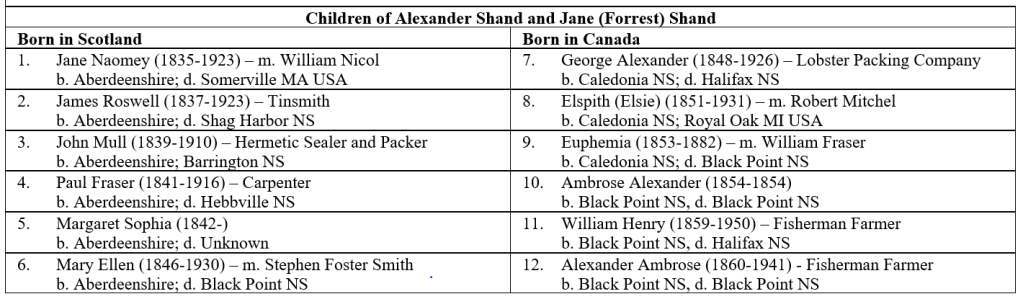
In family genealogy it is always considered a major success to find the actual dates, ports, and even name of the ship detailing their ancestors’ journey to their new homeland. In the case of our family, the first step in this investigation is to identify the window of time when the family might have left Scotland. Since Alexander would have officially relinquished his croft on May 23, 1847, it is quite possible they departed Tyrie around this date. Also, the births of Alexander and Jane’s twelve children might give another clue. With the first six of their children born in Scotland and the latter six born in Canada, this might provide additional insight. A table with information on twelve children is included towards the end of this story.
Obviously, the time period between the births of the sixth and seventh children should be the focus for this exercise in determining date of departure. On February 14, 1846, their sixth child, Mary Ellen, was born in Scotland according to several census records and her death record. What is not clear with Mary Ellen is whether she accompanied the family when she was a baby on their journey to Canada. The 1921 Canada census gives her immigration date to Canada as 1855 when she would have been when she was nine years old. In addition, it is not clear whether Alexander and Jane’s fifth child, Margaret, joined them as well for the trip to Canada as very few records have been found for her at all.
Alexander and Jane’s seventh child and first child born in Canada on October 2, 1848 was George Alexander as listed on his death record. Knowing the family left Scotland between these two birthdates combined with the notice for giving up their farm points to 1847 as the most likely time for boarding a ship bound for Canada. And, if not 1847 then 1848 is the only other logical choice.
Throughout the first half of the 19th Century over 100,000 Scots immigrated to Canada with many bound for Quebec and Ontario but also included a fair number who settled in Nova Scotia and New Brunswick. Some of these vessels were “timber ships” which took emigrants westward from Scotland and loaded timber from New Brunswick for the eastward return trip. This trade had the added advantage of keeping down costs for passenger tickets as the timber trade was quite profitable. During this same period about 15,500 emigrants sailed directly from the Port of Aberdeen to a number of ports in Canada. The Port of Aberdeen (see graphic below) is about forty miles from Tyrie and Alexander and Jane’s home. Unfortunately, passenger lists from most of these ships in the 1840s do not exist so we can only speculate that the Shand family may have set off on one of these for North America.

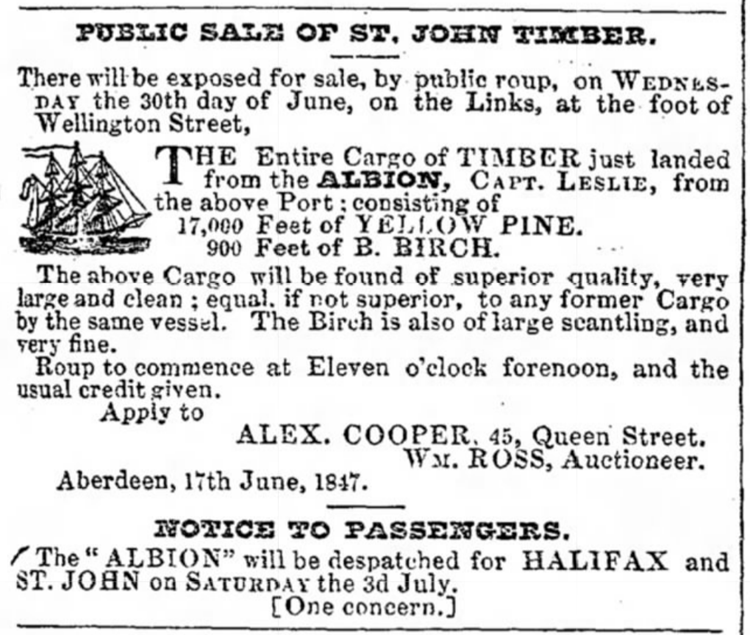
Ship Advertisement in Aberdeen Journal
Since there are very few records describing passengers or even just general information about the ships themselves, we show an example of one such ship. The advertisement below for the ship Albion appeared in the Aberdeen Journal on June 23, 1847, one month after Alexander and Jane were to leave their home. The Albion was scheduled to leave Aberdeen on July 3, 1847 with an estimated arrival in Halifax, Nova Scotia about 40 days later. The advertisement begins with an announcement of a public roup (auction) to offer the sale of timber brought in from St. John, New Brunswick.
The Albion’s master, Captain Alexander Leslie, was well known to residents on both sides of the Atlantic and typically made two round-trips each year for about 23 years. At the bottom of the ad, the Notice to Passengers states the scheduled departure from Aberdeen is July 3, 1847 with destinations of first Halifax and then St. John, New Brunswick. This timing would have been possible for Alexander and Jane’s family but without other sources, it remains purely speculation. Perhaps one of our readers will have further information to fill in the details. One intriguing online reference includes that in 1847, the Ship Albion sailed from Aberdeen and arrived at Halifax with settlers but again, more sources are needed to prove Alexander, Jane, and family were on it.
Arriving in Nova Scotia
Another interesting question for family genealogists is why their ancestors chose to immigrate to one place over another. Alexander and Jane (Forrest) Shand arrived in Nova Scotia with their children most likely in 1847 and first settled in Liverpool in the County of Queens. Shortly after arriving, the family moved to West Caledonia about 35 miles northwest of Liverpool where they constructed a log house and settled down. It was here that their son George Alexander was born in October 1848. Their land in West Caledonia bordered on land owned by Robert and James Forrest who were brothers of Jane (Forrest) Shand and it was this family connection that may have originally motivated Alexander and Jane to choose to come to Queens County, Nova Scotia.
About five years later the family moved back to just outside Liverpool to Mersey Point which is often referred to as Black Point named for the numerous Black families who settled there. During their years living in West Caledonia, Alexander and Jane had three children, George, Elsie, and Euphemia, and three more, Ambrose, William, and Alexander were born after their move to Black Point. In all they had twelve children.
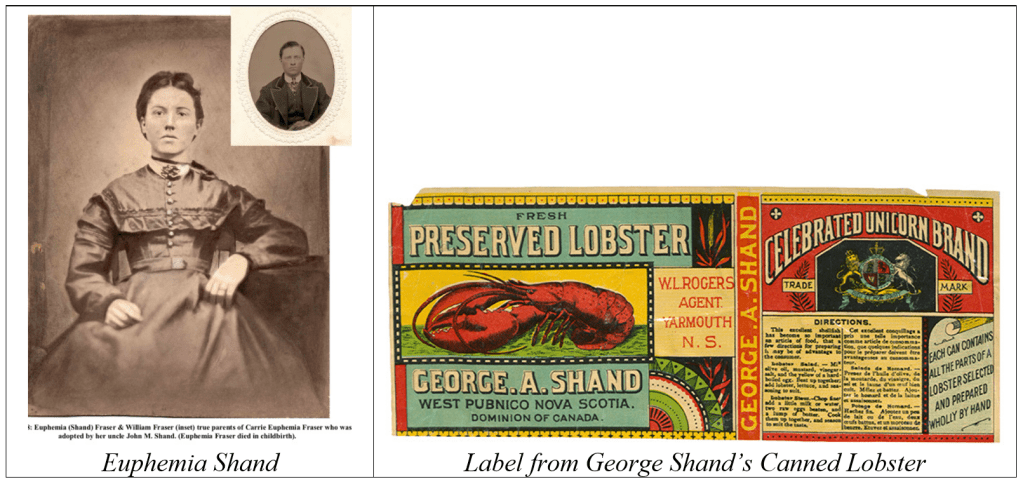
Three of Alexander and Jane’s sons, James, John, and George, were involved with the early canning business that involved hermetically sealing fish, vegetables, and other foods in air-tight tin cans. George’s company as shown in the label below, canned lobsters in his factory in West Pubnico NS. Paul, my great-grandfather, became a carpenter settling in Hebbville in Luneburg County NS. Alexander and Jane’s two youngest sons, William and Alexander, lived close to Black Point and worked as both farmers and fishermen. A seventh son, Ambrose, died in infancy in 1854. Four of their daughters married and raised families with Jane and Elsie eventually immigrating to the United States and Mary and Euphemia settling near Black Point. Euphemia died in childbirth at age 28. She is pictured below along with her husband. As mentioned above, very little is known about Alexander and Jane’s daughter Margaret who was born in Scotland in 1842. It is not known when she died or if she even made the ship voyage to Nova Scotia.
Summary of Alexander and Jane’s Children
Alexander and Jane’s Final Years
Almost four decades ago, I began researching my family’s ancestors. Genealogy is those days involved reading microfilm at LDS libraries, ordering government BMD records, and writing to distant relatives who might have family information. In one such exchange, I had a wonderful conversation with a distant cousin in Winnipeg, Manitoba. He sent me a handwritten family tree that showed Alexander Shand on top with wife Jane and twelve spokes for the children. He an I share Alexander and Jane’s son, Paul, as our direct ancestor. From there the lineage in his tree differs from mine.
One entry in his tree has always caused me to wonder. Next to Alexander Shand’s name, he wrote the following in parentheses; (gold hunter, merchant, farmer, postman). It is well documented that Alexander was a farmer but I have not encountered any source material for the other occupations. Merchant and postman are easy to imagine but gold hunter must have an interesting story to it. I will continue this search. In any event, Alexander and Jane certainly had interesting lives and presided over new generations of the Shand family with some taking root in Nova Scotia and some venturing to other lands. Today, their descendants must number in the hundreds including this author who is now five generations removed.
And so, our story ends where it began. As seen by her tombstone below, Jane (Forrest) Shand died July 29, 1881, aged 68 years in Black Point NS. This “native of Aberdeenshire” is buried in the Anglican Cemetery in Liverpool NS. In 1884, Alexander Shand married a second wife, Julia Lowe, in Liverpool NS. Alexander died April 18, 1897 in Black Point NS. Julia Lowe died November 1, 1903 in Liverpool NS.
The photo of the man below is purported to be Alexander Shand and has been widely disseminated online in family trees. I have never seen and other information about it and would like to hear from anyone who might know. The photo appears to be cropped from a larger group photo.

Call for Comments
As with all ancestor stories on our website, we try our best to be as accurate as possible but we call on readers to let us know if they find inaccuracies. Our goal ultimately is to share our ancestors’ experiences and accomplishments. This is done by combining information from their genealogy records with historical facts to give context and then discussing possible conjectures that may arise. In this way, we hope to fill in gaps to better understand our ancestors’ lives.
Respectfully,
Raymond Frederick Tennant
Alexander and Jane’s great-great-grandson
 Tennant, Shand, Nicolle, Allen Ancestor Stories